Aphrodite of Knidos Mask - Item #260
14.25 Inches High x 9.5 Inches Wide x 8 Inches Deep
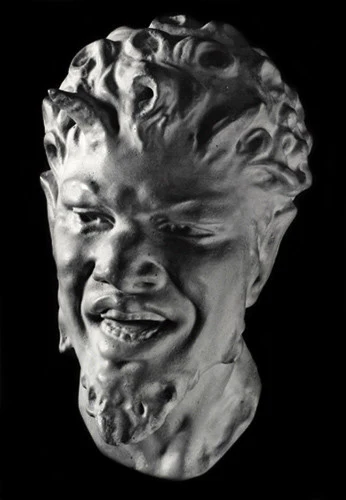
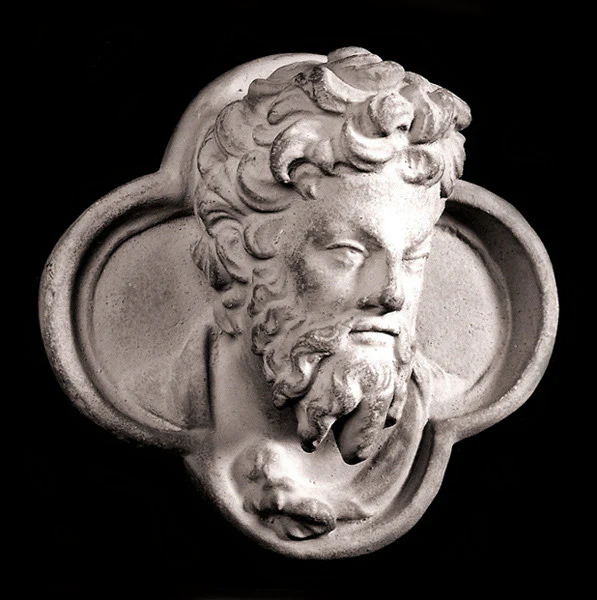
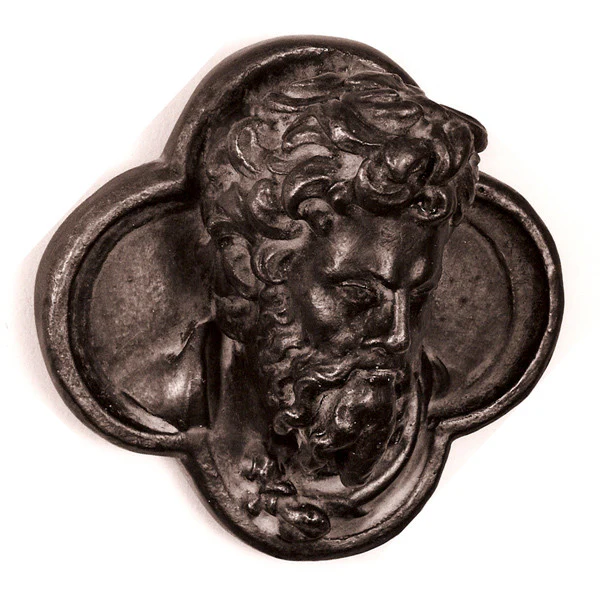
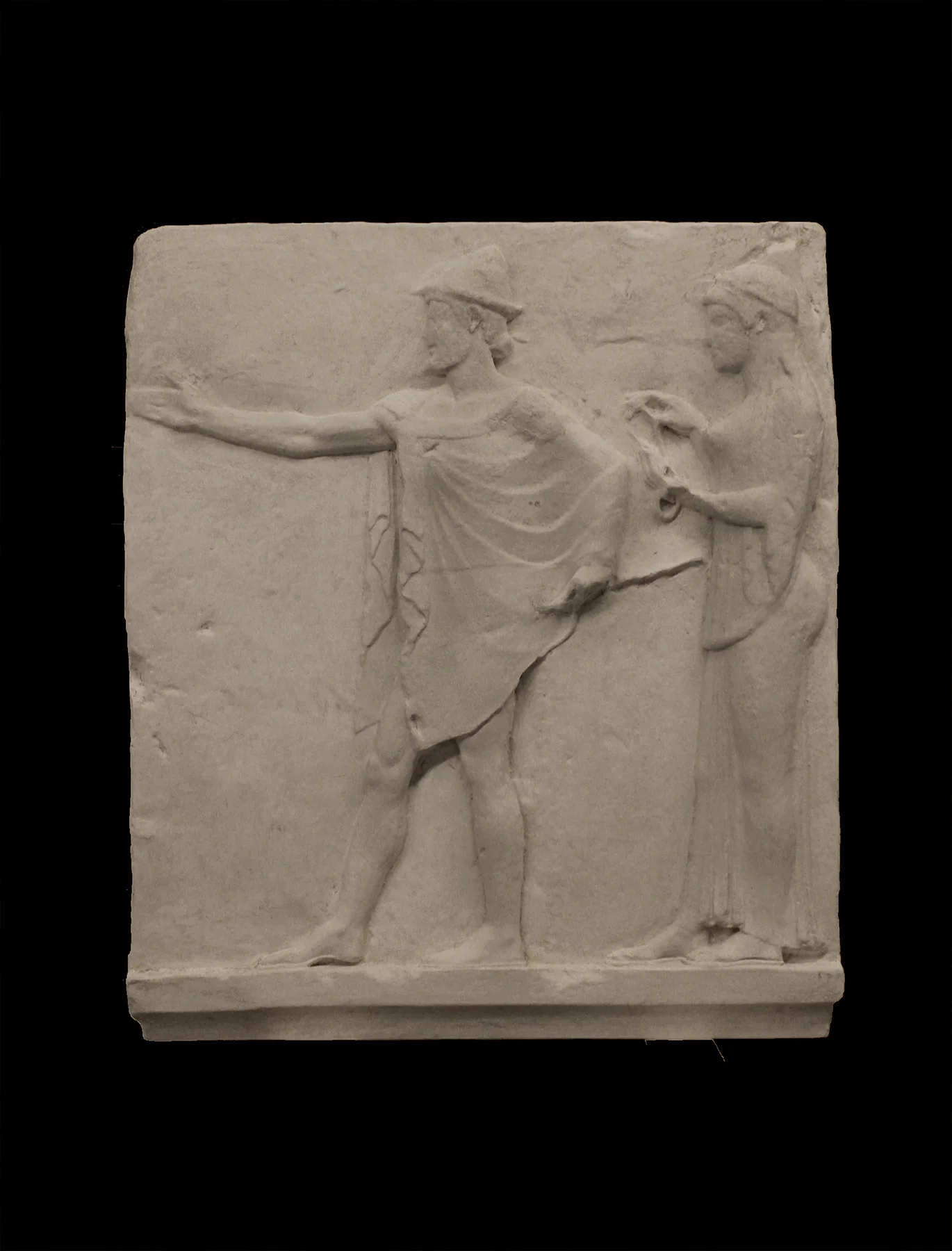
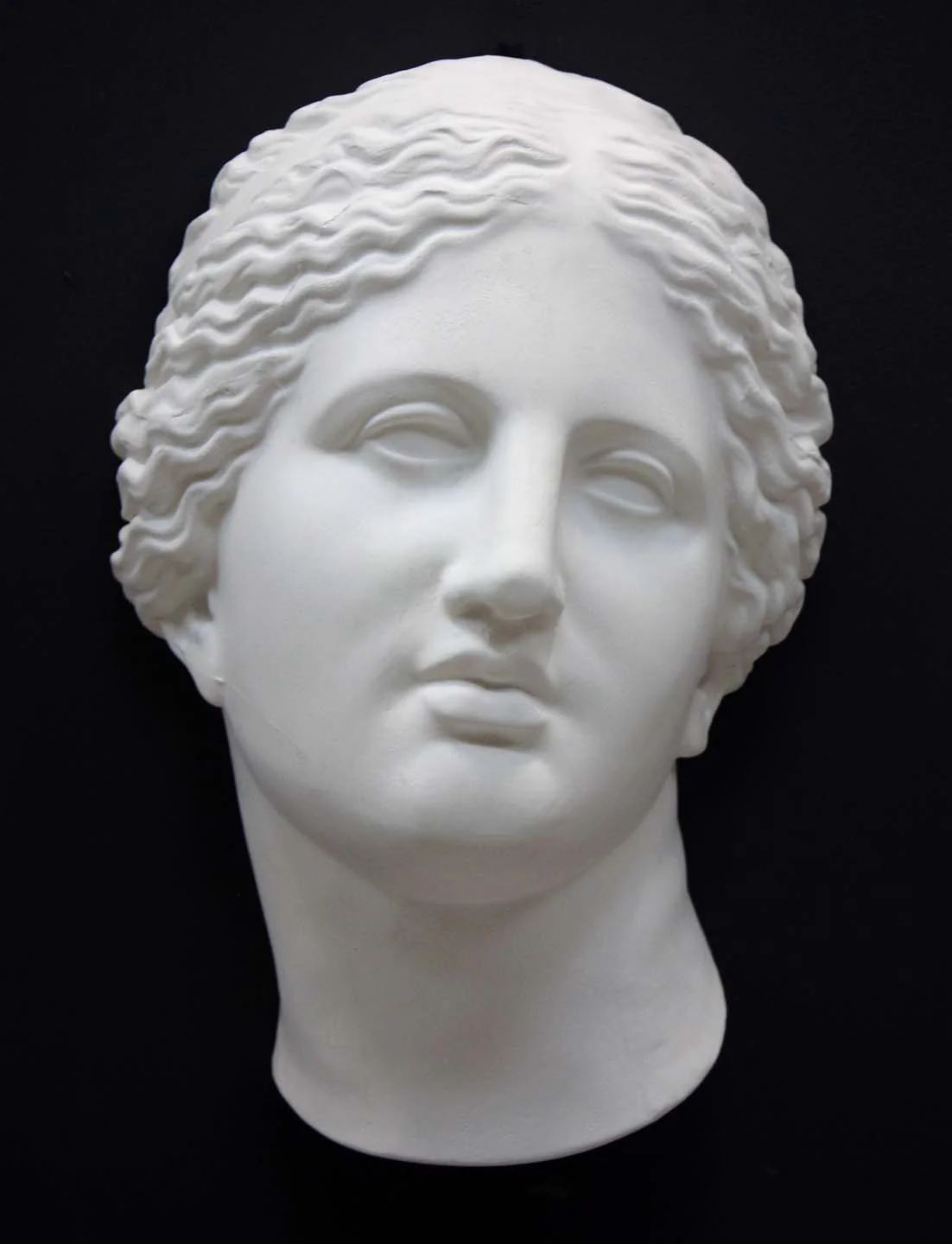
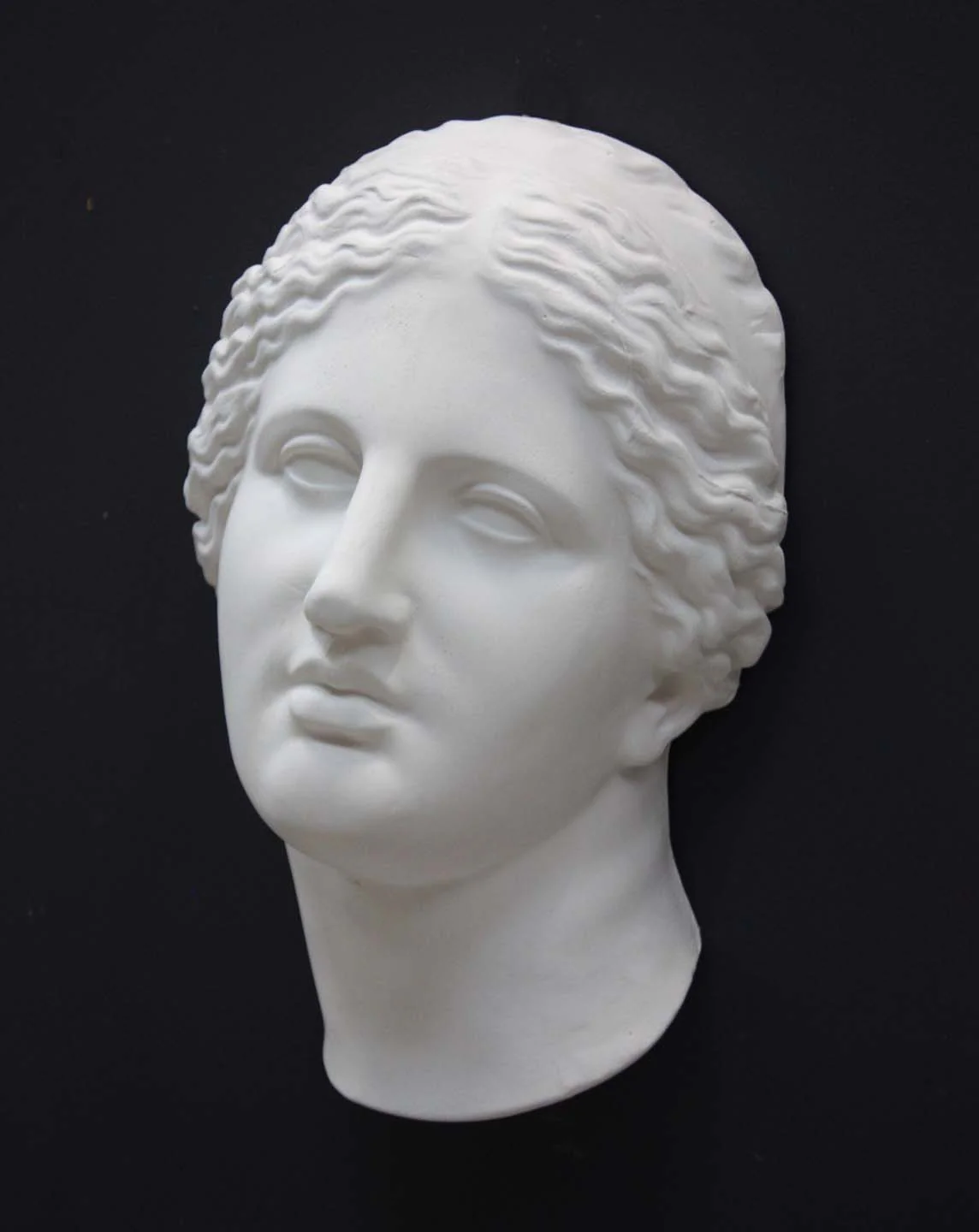
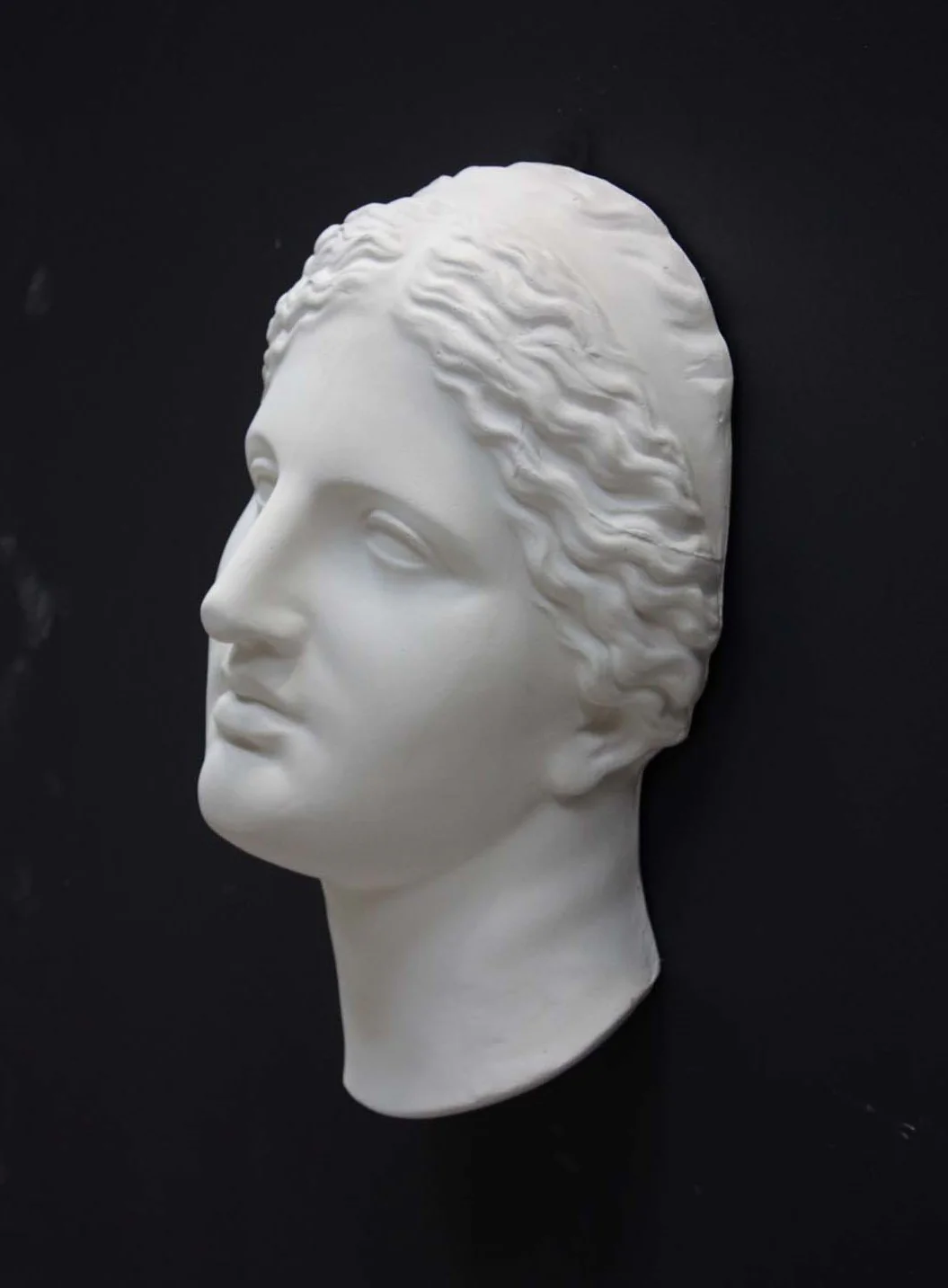
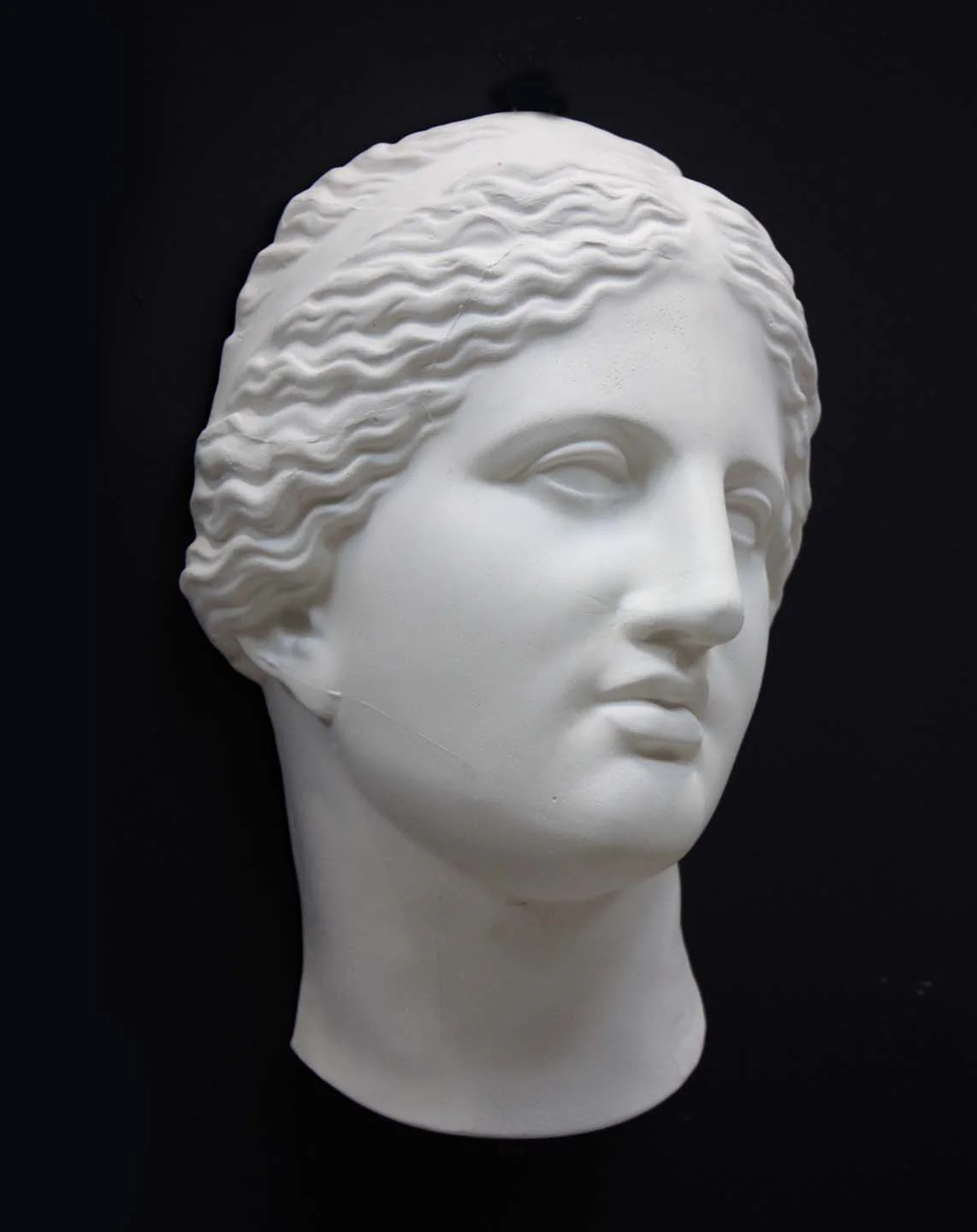
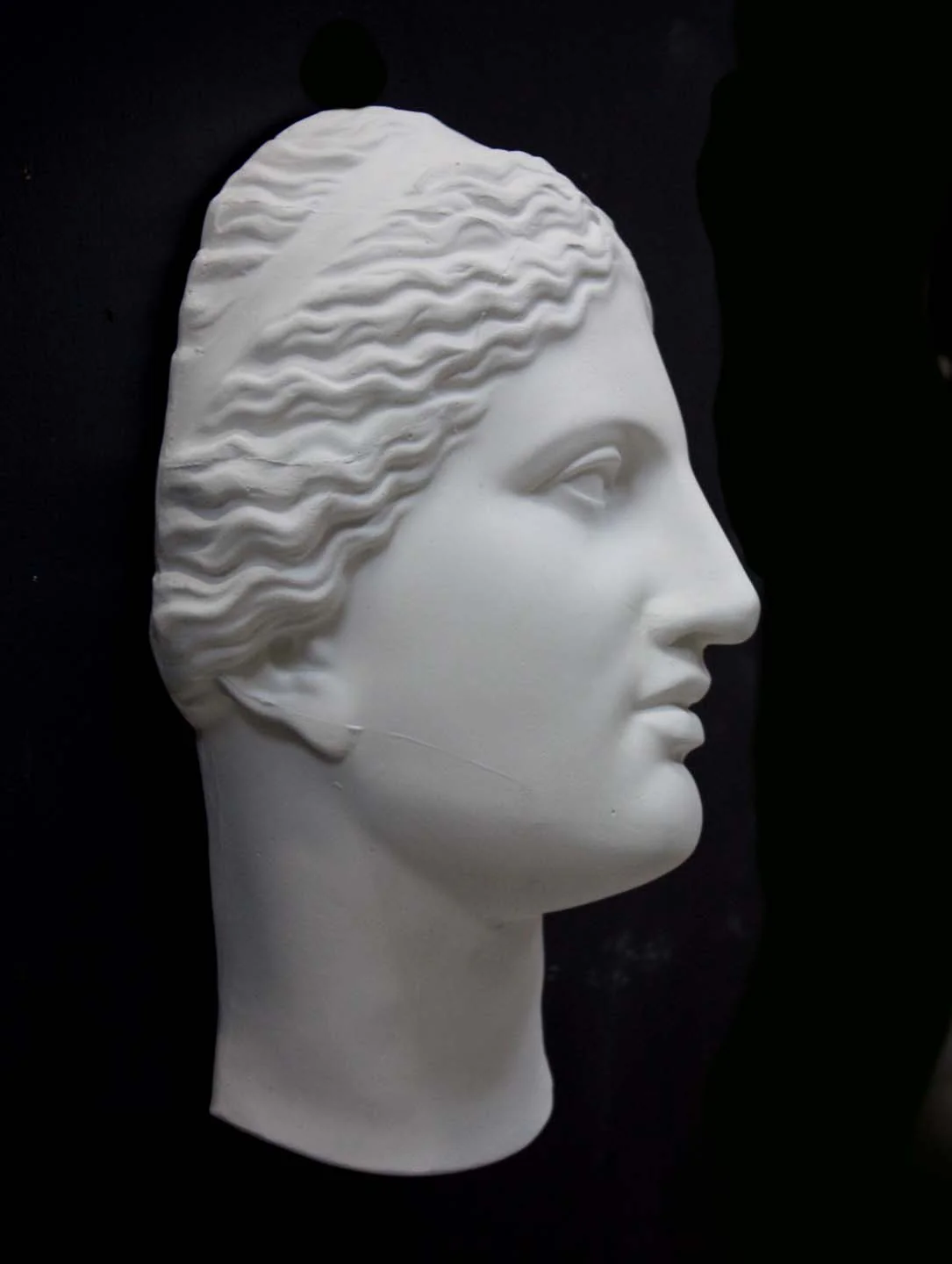
Life-size mask. The Aphrodite of Knidos, also known as the Venus of Cnidus, was the first life-size statue of a goddess or female depicted in the nude when Praxiteles sculpted it in the 4th century B.C.E. It is considered his greatest work, and it set a precedent for future depictions of the idealized female body. The people of Knidos (which was a Greek island and city in modern-day Turkey) placed Praxiteles's marble statue in the Temple of Aphrodite where it received renown and pilgrims. Although the original no longer exists, there are many surviving Roman copies - though not exact replicas - including the Colonna Venus located in the Vatican Museums and the Kaufmann Head in the Louvre. The figure, standing in contrapposto, is shown preparing for her ritual bath - dropping her clothes and in turn, using a hand to cover her pubic area which consequently leaves her breasts exposed. Aphrodite wears her wavy hair pulled back and adorned with two narrow head pieces. Her head, with its idealized face, is tilted down and to the left. On the cast in our collection, we have left intact the seam lines created during the old moldmaking process used in the past.
Artist: Praxiteles
Museum: Pio Clementino Museum, Vatican Museums, Vatican City and Louvre Museum, Paris
Time Period: Ancient Greek, c. 350 B.C.E./Ancient Roman, 2nd century C.E.
1911 Catalog ID # - 13485
Sources:
"Aphrodite of Knidos." Museum number 233. Museum of Classical Archaeology Databases. University of Cambridge, UK, https://museum.classics.cam.ac.uk/collections/casts/aphrodite-knidos-0.
"Aphrodite of Knidos." Museum number Sage no. 253 and 282. Cornell University Library Digital Collections, https://digital.library.cornell.edu/catalog/ss:172716.
Astier, Marie-Bénédicte. "Female head, Modeled from the Aphrodite of Cnidus." Museum number MND 2027 and Ma 3518. Louvre Museum, https://www.louvre.fr/en/oeuvre-notices/female-head-modeled-aphrodite-cnidus.
The Editors of Encyclopædia Britannica. "Cnidus." Encyclopædia Britannica, https://www.britannica.com/place/Cnidus.
The Editors of Encyclopædia Britannica. "Praxiteles." Encyclopædia Britannica, https://www.britannica.com/biography/Praxiteles.
"Statue of the Aphrodite of Knidos." Museum number 1981.11. The Art Institute of Chicago, https://www.artic.edu/artworks/61600/statue-of-the-aphrodite-of-knidos.
More Images
Aphrodite of Knidos Mask - Item #260
14.25 Inches High x 9.5 Inches Wide x 8 Inches Deep
Life-size mask. The Aphrodite of Knidos, also known as the Venus of Cnidus, was the first life-size statue of a goddess or female depicted in the nude when Praxiteles sculpted it in the 4th century B.C.E. It is considered his greatest work, and it set a precedent for future depictions of the idealized female body. The people of Knidos (which was a Greek island and city in modern-day Turkey) placed Praxiteles's marble statue in the Temple of Aphrodite where it received renown and pilgrims. Although the original no longer exists, there are many surviving Roman copies - though not exact replicas - including the Colonna Venus located in the Vatican Museums and the Kaufmann Head in the Louvre. The figure, standing in contrapposto, is shown preparing for her ritual bath - dropping her clothes and in turn, using a hand to cover her pubic area which consequently leaves her breasts exposed. Aphrodite wears her wavy hair pulled back and adorned with two narrow head pieces. Her head, with its idealized face, is tilted down and to the left. On the cast in our collection, we have left intact the seam lines created during the old moldmaking process used in the past.
Artist: Praxiteles
Museum: Pio Clementino Museum, Vatican Museums, Vatican City and Louvre Museum, Paris
Time Period: Ancient Greek, c. 350 B.C.E./Ancient Roman, 2nd century C.E.
1911 Catalog ID # - 13485
Sources:
"Aphrodite of Knidos." Museum number 233. Museum of Classical Archaeology Databases. University of Cambridge, UK, https://museum.classics.cam.ac.uk/collections/casts/aphrodite-knidos-0.
"Aphrodite of Knidos." Museum number Sage no. 253 and 282. Cornell University Library Digital Collections, https://digital.library.cornell.edu/catalog/ss:172716.
Astier, Marie-Bénédicte. "Female head, Modeled from the Aphrodite of Cnidus." Museum number MND 2027 and Ma 3518. Louvre Museum, https://www.louvre.fr/en/oeuvre-notices/female-head-modeled-aphrodite-cnidus.
The Editors of Encyclopædia Britannica. "Cnidus." Encyclopædia Britannica, https://www.britannica.com/place/Cnidus.
The Editors of Encyclopædia Britannica. "Praxiteles." Encyclopædia Britannica, https://www.britannica.com/biography/Praxiteles.
"Statue of the Aphrodite of Knidos." Museum number 1981.11. The Art Institute of Chicago, https://www.artic.edu/artworks/61600/statue-of-the-aphrodite-of-knidos.
Product Information
Product Information
Shipping & Returns
Shipping & Returns
Description
14.25 Inches High x 9.5 Inches Wide x 8 Inches Deep
Life-size mask. The Aphrodite of Knidos, also known as the Venus of Cnidus, was the first life-size statue of a goddess or female depicted in the nude when Praxiteles sculpted it in the 4th century B.C.E. It is considered his greatest work, and it set a precedent for future depictions of the idealized female body. The people of Knidos (which was a Greek island and city in modern-day Turkey) placed Praxiteles's marble statue in the Temple of Aphrodite where it received renown and pilgrims. Although the original no longer exists, there are many surviving Roman copies - though not exact replicas - including the Colonna Venus located in the Vatican Museums and the Kaufmann Head in the Louvre. The figure, standing in contrapposto, is shown preparing for her ritual bath - dropping her clothes and in turn, using a hand to cover her pubic area which consequently leaves her breasts exposed. Aphrodite wears her wavy hair pulled back and adorned with two narrow head pieces. Her head, with its idealized face, is tilted down and to the left. On the cast in our collection, we have left intact the seam lines created during the old moldmaking process used in the past.
Artist: Praxiteles
Museum: Pio Clementino Museum, Vatican Museums, Vatican City and Louvre Museum, Paris
Time Period: Ancient Greek, c. 350 B.C.E./Ancient Roman, 2nd century C.E.
1911 Catalog ID # - 13485
Sources:
"Aphrodite of Knidos." Museum number 233. Museum of Classical Archaeology Databases. University of Cambridge, UK, https://museum.classics.cam.ac.uk/collections/casts/aphrodite-knidos-0.
"Aphrodite of Knidos." Museum number Sage no. 253 and 282. Cornell University Library Digital Collections, https://digital.library.cornell.edu/catalog/ss:172716.
Astier, Marie-Bénédicte. "Female head, Modeled from the Aphrodite of Cnidus." Museum number MND 2027 and Ma 3518. Louvre Museum, https://www.louvre.fr/en/oeuvre-notices/female-head-modeled-aphrodite-cnidus.
The Editors of Encyclopædia Britannica. "Cnidus." Encyclopædia Britannica, https://www.britannica.com/place/Cnidus.
The Editors of Encyclopædia Britannica. "Praxiteles." Encyclopædia Britannica, https://www.britannica.com/biography/Praxiteles.
"Statue of the Aphrodite of Knidos." Museum number 1981.11. The Art Institute of Chicago, https://www.artic.edu/artworks/61600/statue-of-the-aphrodite-of-knidos.