Apollo in Chariot - Item #176
18 Inches High x 37 Inches Wide
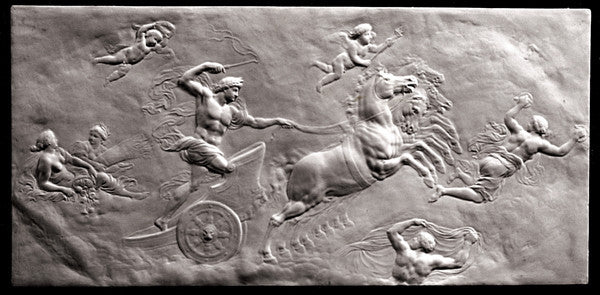
In this low relief, a horse-drawn chariot with a male rider flies through the sky while other gods, goddesses, and putti are flying or resting on clouds. The male figure in the chariot may be Apollo or Helios. The two Greek gods started being conflated by the Romans sometime after the first century B.C.E. Apollo was one of the most revered gods and had many roles, while Helios was the god of the sun. Helios brought about each new day in his chariot. Once the Romans started to view Apollo as being related to the sun, the conflation of the two began, and Apollo was often depicted performing this duty.
This sculpture is a modern work made prior to the 20th century. It's possible the original was created by Nicolas Coustou (1658-1733) or Guillaume Coustou (1677-1746), French brothers who sculpted in the Rococo style. A metal reproduction of this relief bears one of the signatures they used, "Coustou fecit." The brothers completed sculptures and architectural sculpture at the estate of Marly as well as at Versailles.
Artist: Unknown
Museum: Unknown
Time Period: Modern
1911 Catalog ID # - 10030
Sources:
Schmitz, Leonhard. "Apollo." A Dictionary of Greek and Roman Biography and Mythology, edited by William Smith, 1849. Tufts University: Perseus Digital Library, Gregory R. Crane (editor-in-chief), http://www.perseus.tufts.edu/hopper/text?doc=Perseus:text:1999.04.0104:entry=apollo-bio-1.
Schmitz, Leonhard. "He'lios." A Dictionary of Greek and Roman Biography and Mythology, edited by William Smith, 1849. Tufts University: Perseus Digital Library, Gregory R. Crane (editor-in-chief), http://www.perseus.tufts.edu/hopper/text?doc=Perseus:text:1999.04.0104:entry=helios-bio-1.
Original: $550.00
-65%$550.00
$192.50Apollo in Chariot - Item #176
18 Inches High x 37 Inches Wide
In this low relief, a horse-drawn chariot with a male rider flies through the sky while other gods, goddesses, and putti are flying or resting on clouds. The male figure in the chariot may be Apollo or Helios. The two Greek gods started being conflated by the Romans sometime after the first century B.C.E. Apollo was one of the most revered gods and had many roles, while Helios was the god of the sun. Helios brought about each new day in his chariot. Once the Romans started to view Apollo as being related to the sun, the conflation of the two began, and Apollo was often depicted performing this duty.
This sculpture is a modern work made prior to the 20th century. It's possible the original was created by Nicolas Coustou (1658-1733) or Guillaume Coustou (1677-1746), French brothers who sculpted in the Rococo style. A metal reproduction of this relief bears one of the signatures they used, "Coustou fecit." The brothers completed sculptures and architectural sculpture at the estate of Marly as well as at Versailles.
Artist: Unknown
Museum: Unknown
Time Period: Modern
1911 Catalog ID # - 10030
Sources:
Schmitz, Leonhard. "Apollo." A Dictionary of Greek and Roman Biography and Mythology, edited by William Smith, 1849. Tufts University: Perseus Digital Library, Gregory R. Crane (editor-in-chief), http://www.perseus.tufts.edu/hopper/text?doc=Perseus:text:1999.04.0104:entry=apollo-bio-1.
Schmitz, Leonhard. "He'lios." A Dictionary of Greek and Roman Biography and Mythology, edited by William Smith, 1849. Tufts University: Perseus Digital Library, Gregory R. Crane (editor-in-chief), http://www.perseus.tufts.edu/hopper/text?doc=Perseus:text:1999.04.0104:entry=helios-bio-1.
Product Information
Product Information
Shipping & Returns
Shipping & Returns
Description
18 Inches High x 37 Inches Wide
In this low relief, a horse-drawn chariot with a male rider flies through the sky while other gods, goddesses, and putti are flying or resting on clouds. The male figure in the chariot may be Apollo or Helios. The two Greek gods started being conflated by the Romans sometime after the first century B.C.E. Apollo was one of the most revered gods and had many roles, while Helios was the god of the sun. Helios brought about each new day in his chariot. Once the Romans started to view Apollo as being related to the sun, the conflation of the two began, and Apollo was often depicted performing this duty.
This sculpture is a modern work made prior to the 20th century. It's possible the original was created by Nicolas Coustou (1658-1733) or Guillaume Coustou (1677-1746), French brothers who sculpted in the Rococo style. A metal reproduction of this relief bears one of the signatures they used, "Coustou fecit." The brothers completed sculptures and architectural sculpture at the estate of Marly as well as at Versailles.
Artist: Unknown
Museum: Unknown
Time Period: Modern
1911 Catalog ID # - 10030
Sources:
Schmitz, Leonhard. "Apollo." A Dictionary of Greek and Roman Biography and Mythology, edited by William Smith, 1849. Tufts University: Perseus Digital Library, Gregory R. Crane (editor-in-chief), http://www.perseus.tufts.edu/hopper/text?doc=Perseus:text:1999.04.0104:entry=apollo-bio-1.
Schmitz, Leonhard. "He'lios." A Dictionary of Greek and Roman Biography and Mythology, edited by William Smith, 1849. Tufts University: Perseus Digital Library, Gregory R. Crane (editor-in-chief), http://www.perseus.tufts.edu/hopper/text?doc=Perseus:text:1999.04.0104:entry=helios-bio-1.