Beethoven Life Mask - Item #258
10.5 Inches High x 7 Inches Wide x 5.5 Inches Deep
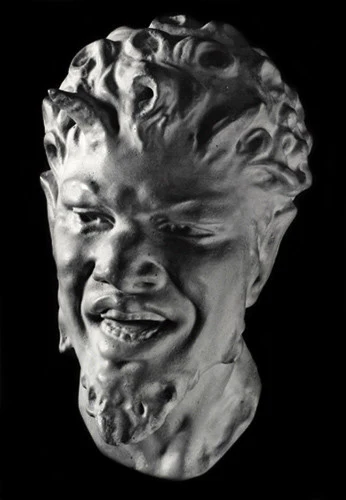
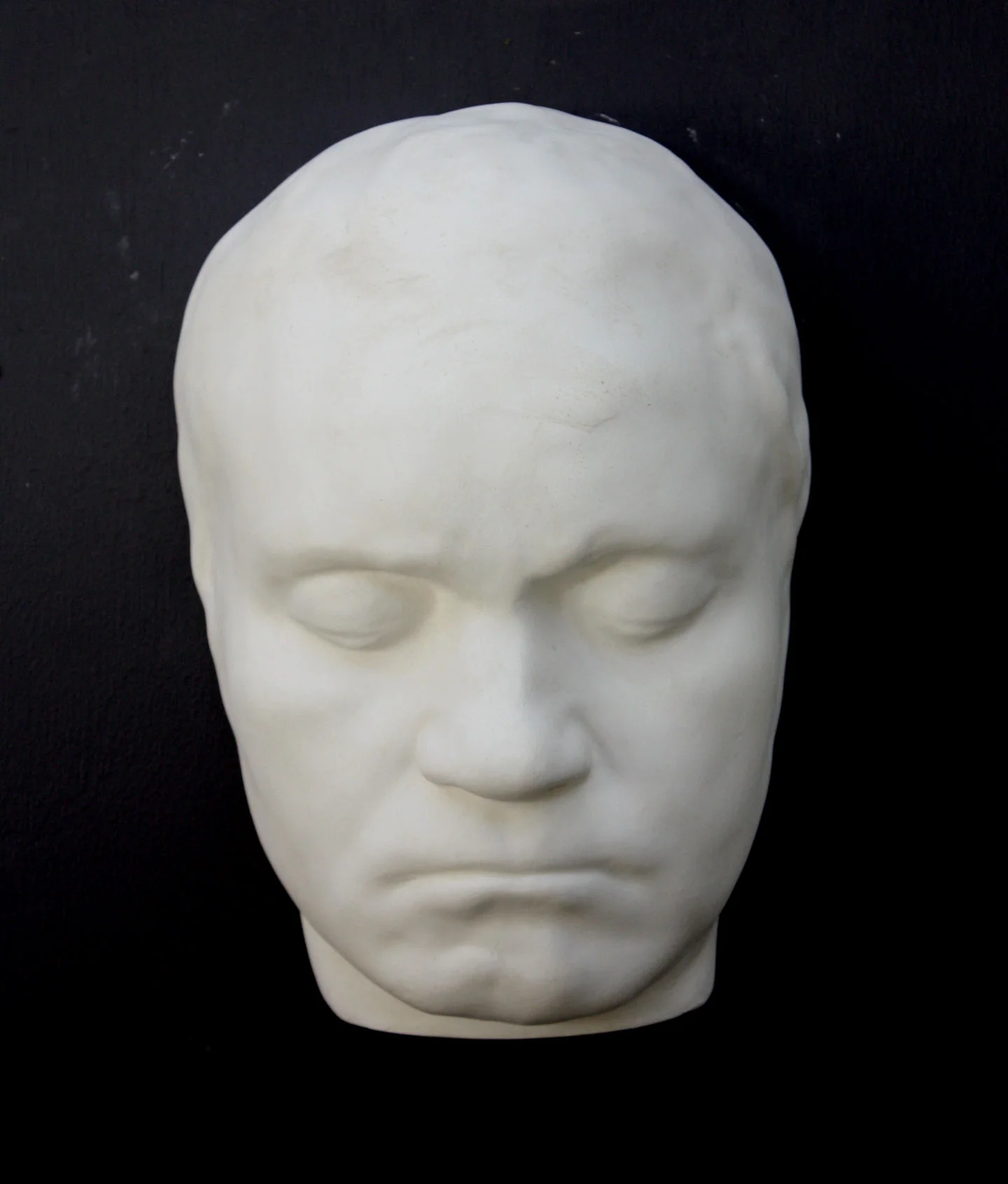
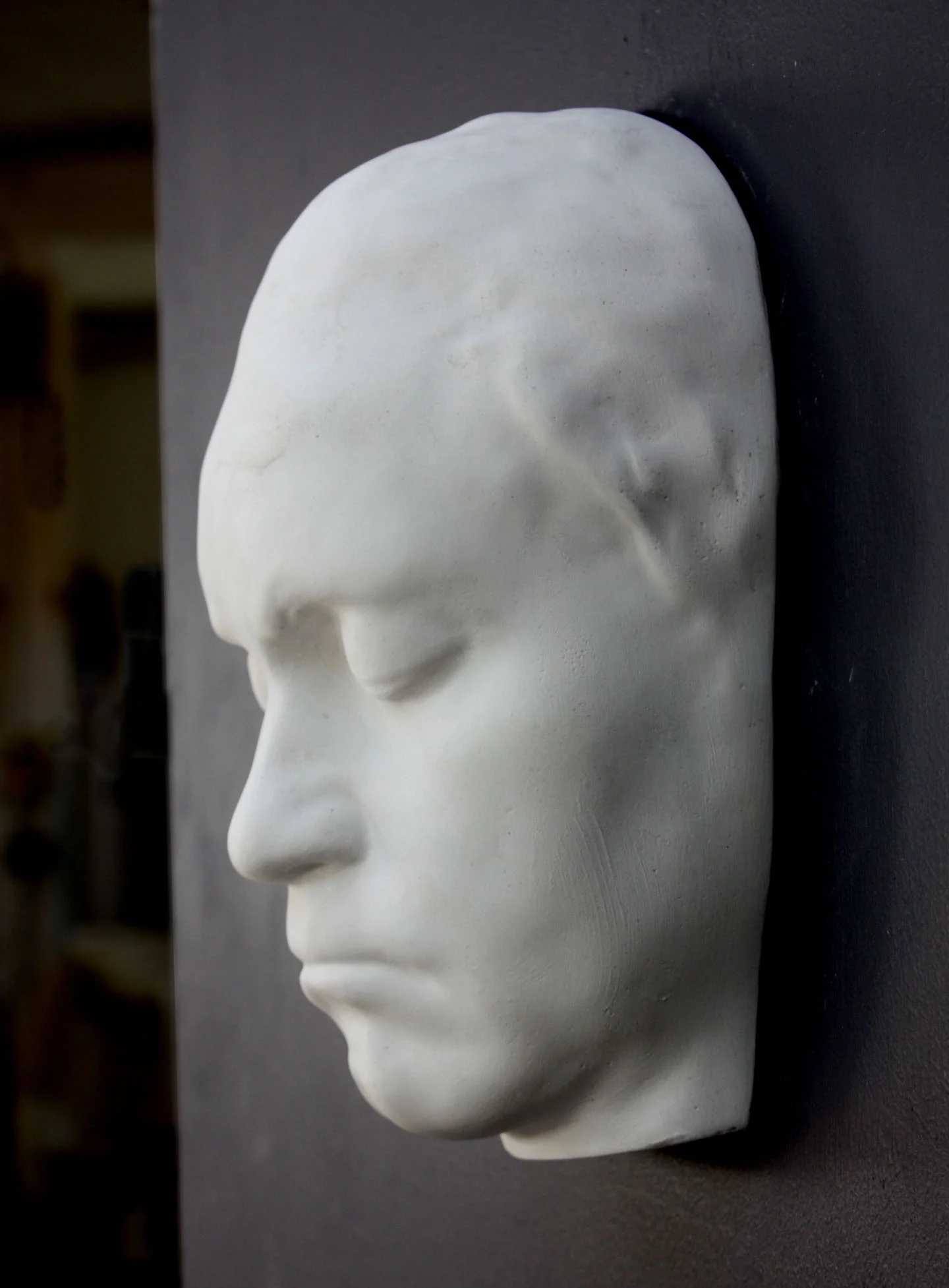
In 1812, Austrian sculptor Franz Klein (1779-1840) made a life mask of Ludwig van Beethoven, the famed German composer who lived from 1770 to 1827. Beethoven was 42 years old when he had the plaster cast taken of his face. The sculptor created the mask in preparation for a bust commissioned by Beethoven’s friends - the piano manufacturers Andreas and Nannette Streicher - for their concert hall.
Masks of famous figures, especially composers, were popular wall decorations in middle-class homes in the 19th century. This trend arose from the interest in the physiognomies of famous artists. Possessing and displaying a mask as homage or as a memorial to the person depicted signaled the owner’s social class and their high regard for culture. Beethoven’s mask served this same function in Germany and Austria, where consumers purchased the mass-produced plaster casts and placed them in their homes, especially in their music rooms. This life mask was incorrectly known and referred to as a death mask through the turn of the 20th century, likely due to consumers treating it as an object of mourning.
The life mask quickly became a model for artistic representations of Beethoven (such as the bust by Hugo Hagen) and illustrations of the composer used on various consumer goods. The prolific use of the mask’s image made Beethoven’s face extremely recognizable. People considered the life mask a true depiction of his usual countenance, although his expression was possibly a consequence of the uncomfortable life-casting process, as has been suggested by some scholars.
Antique copies of the life mask can be found in museums and collections around the world, including the Beethoven-Haus Bonn in Bonn, Germany and the Isabella Stewart Gardner Museum in Boston, Massachusetts, USA.
Artist: Franz Klein
Museum: Various including Beethoven-Haus Bonn in Bonn, Germany and the Isabella Stewart Gardner Museum in Boston, Massachusetts, USA
Time Period: Modern, 1812
1911 Catalog ID # - 13503
Sources:
"Beethoven monuments of the 19th and 20th century: 1800-1830 Beginning and precursors." Beethoven-Haus Bonn, https://internet.beethoven.de/en/exhibition/beethoven-monuments-of-the-19th-and-20th-century/id0.html.
"Explore the artefacts on display in the Beethoven Factory." Ringve Music Museum, https://ringve.no/en/objects-beethoven.
Fine, Abigail. Objects of Veneration: Music and Materiality in the Composer-Cults of Germany and Austria, 1870-1930. 2017. The University of Chicago, Illinois. Dissertation. Knowledge@UChicago, https://knowledge.uchicago.edu/record/898?ln=en.
"Franz Klein - Life mask of Ludwig van Beethoven, after 1812." Isabella Stewart Gardner Museum, https://www.gardnermuseum.org/experience/collection/19753.
Knapp, Raymond L., and Julian Medforth Budden. "Ludwig van Beethoven." Encyclopædia Britannica, https://www.britannica.com/biography/Ludwig-van-Beethoven.
Original: $275.00
-65%$275.00
$96.25More Images
Beethoven Life Mask - Item #258
10.5 Inches High x 7 Inches Wide x 5.5 Inches Deep
In 1812, Austrian sculptor Franz Klein (1779-1840) made a life mask of Ludwig van Beethoven, the famed German composer who lived from 1770 to 1827. Beethoven was 42 years old when he had the plaster cast taken of his face. The sculptor created the mask in preparation for a bust commissioned by Beethoven’s friends - the piano manufacturers Andreas and Nannette Streicher - for their concert hall.
Masks of famous figures, especially composers, were popular wall decorations in middle-class homes in the 19th century. This trend arose from the interest in the physiognomies of famous artists. Possessing and displaying a mask as homage or as a memorial to the person depicted signaled the owner’s social class and their high regard for culture. Beethoven’s mask served this same function in Germany and Austria, where consumers purchased the mass-produced plaster casts and placed them in their homes, especially in their music rooms. This life mask was incorrectly known and referred to as a death mask through the turn of the 20th century, likely due to consumers treating it as an object of mourning.
The life mask quickly became a model for artistic representations of Beethoven (such as the bust by Hugo Hagen) and illustrations of the composer used on various consumer goods. The prolific use of the mask’s image made Beethoven’s face extremely recognizable. People considered the life mask a true depiction of his usual countenance, although his expression was possibly a consequence of the uncomfortable life-casting process, as has been suggested by some scholars.
Antique copies of the life mask can be found in museums and collections around the world, including the Beethoven-Haus Bonn in Bonn, Germany and the Isabella Stewart Gardner Museum in Boston, Massachusetts, USA.
Artist: Franz Klein
Museum: Various including Beethoven-Haus Bonn in Bonn, Germany and the Isabella Stewart Gardner Museum in Boston, Massachusetts, USA
Time Period: Modern, 1812
1911 Catalog ID # - 13503
Sources:
"Beethoven monuments of the 19th and 20th century: 1800-1830 Beginning and precursors." Beethoven-Haus Bonn, https://internet.beethoven.de/en/exhibition/beethoven-monuments-of-the-19th-and-20th-century/id0.html.
"Explore the artefacts on display in the Beethoven Factory." Ringve Music Museum, https://ringve.no/en/objects-beethoven.
Fine, Abigail. Objects of Veneration: Music and Materiality in the Composer-Cults of Germany and Austria, 1870-1930. 2017. The University of Chicago, Illinois. Dissertation. Knowledge@UChicago, https://knowledge.uchicago.edu/record/898?ln=en.
"Franz Klein - Life mask of Ludwig van Beethoven, after 1812." Isabella Stewart Gardner Museum, https://www.gardnermuseum.org/experience/collection/19753.
Knapp, Raymond L., and Julian Medforth Budden. "Ludwig van Beethoven." Encyclopædia Britannica, https://www.britannica.com/biography/Ludwig-van-Beethoven.
Product Information
Product Information
Shipping & Returns
Shipping & Returns
Description
10.5 Inches High x 7 Inches Wide x 5.5 Inches Deep
In 1812, Austrian sculptor Franz Klein (1779-1840) made a life mask of Ludwig van Beethoven, the famed German composer who lived from 1770 to 1827. Beethoven was 42 years old when he had the plaster cast taken of his face. The sculptor created the mask in preparation for a bust commissioned by Beethoven’s friends - the piano manufacturers Andreas and Nannette Streicher - for their concert hall.
Masks of famous figures, especially composers, were popular wall decorations in middle-class homes in the 19th century. This trend arose from the interest in the physiognomies of famous artists. Possessing and displaying a mask as homage or as a memorial to the person depicted signaled the owner’s social class and their high regard for culture. Beethoven’s mask served this same function in Germany and Austria, where consumers purchased the mass-produced plaster casts and placed them in their homes, especially in their music rooms. This life mask was incorrectly known and referred to as a death mask through the turn of the 20th century, likely due to consumers treating it as an object of mourning.
The life mask quickly became a model for artistic representations of Beethoven (such as the bust by Hugo Hagen) and illustrations of the composer used on various consumer goods. The prolific use of the mask’s image made Beethoven’s face extremely recognizable. People considered the life mask a true depiction of his usual countenance, although his expression was possibly a consequence of the uncomfortable life-casting process, as has been suggested by some scholars.
Antique copies of the life mask can be found in museums and collections around the world, including the Beethoven-Haus Bonn in Bonn, Germany and the Isabella Stewart Gardner Museum in Boston, Massachusetts, USA.
Artist: Franz Klein
Museum: Various including Beethoven-Haus Bonn in Bonn, Germany and the Isabella Stewart Gardner Museum in Boston, Massachusetts, USA
Time Period: Modern, 1812
1911 Catalog ID # - 13503
Sources:
"Beethoven monuments of the 19th and 20th century: 1800-1830 Beginning and precursors." Beethoven-Haus Bonn, https://internet.beethoven.de/en/exhibition/beethoven-monuments-of-the-19th-and-20th-century/id0.html.
"Explore the artefacts on display in the Beethoven Factory." Ringve Music Museum, https://ringve.no/en/objects-beethoven.
Fine, Abigail. Objects of Veneration: Music and Materiality in the Composer-Cults of Germany and Austria, 1870-1930. 2017. The University of Chicago, Illinois. Dissertation. Knowledge@UChicago, https://knowledge.uchicago.edu/record/898?ln=en.
"Franz Klein - Life mask of Ludwig van Beethoven, after 1812." Isabella Stewart Gardner Museum, https://www.gardnermuseum.org/experience/collection/19753.
Knapp, Raymond L., and Julian Medforth Budden. "Ludwig van Beethoven." Encyclopædia Britannica, https://www.britannica.com/biography/Ludwig-van-Beethoven.